
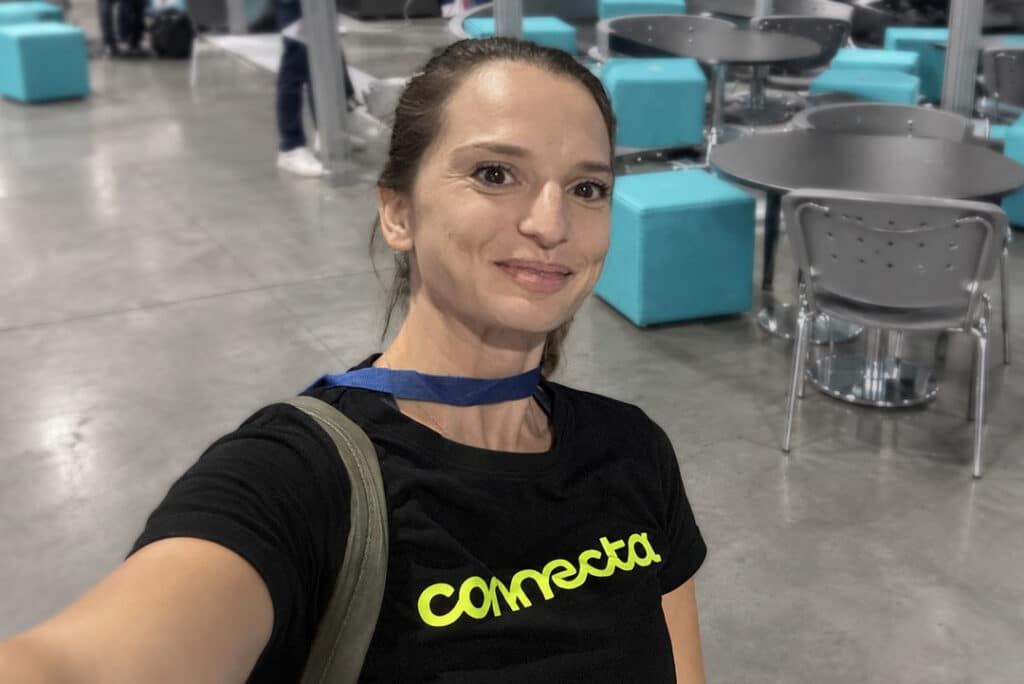
Denitsa Anastasova, Co-founder and CEO of Connecta Education
What is the role of technology in education today, in your view?
In my view, the greatest opportunity technology offers is not providing more information. We already have information in abundance. The real question is how we turn it into knowledge and understanding.
Today, a student can get an answer to almost any question in seconds. But that does not mean they have learned anything.
I see the role of technology through three very simple principles: Mistakes. Questions. Explain in your own words.
First, we need to identify what a child has not understood. Then we need to guide them with the right questions. Finally, we need to encourage them to explain what they have learned themselves. In China, there is a practice called Cuò Tí Běn – the notebook of mistakes. Students record the problems they have answered incorrectly, analyse the reasons and revisit them until they master the underlying principle. Imagine if we could digitise this process. Every mistake could be linked to a specific skill, and technology could suggest exercises tailored to that particular gap. Instead of all children learning the same things in the same way, we could help each student work on their own individual learning gaps.
For me, the future of education is not about generating more content, but about developing deeper understanding.
What skills and competencies can students develop through technology?
Technology can help develop critical thinking, independence, curiosity, analytical skills and problem-solving abilities. But only if it is designed with that purpose in mind. Let me share an example I particularly like.
More than 2,400 years ago, Socrates asked the military commander Laches: “What does it mean to be courageous?” Laches replied that a courageous person is someone who stands their ground on the battlefield and does not retreat in the face of the enemy. But Socrates reminded him of the Battle of Plataea in 479 BC. In his account, the Spartans initially retreated before the Persians. When the Persian ranks became disorganised, the Spartans turned around, attacked and won the battle. If the Spartans retreated and were still courageous, does that mean courage is not simply about standing your ground?
Socrates did not provide a ready-made answer. Instead, he encouraged Laches to discover the contradiction in his own definition. That is precisely what I want technology to do. Not simply provide answers, but ask questions. Encourage children to formulate hypotheses, test them, look for evidence and change their position when they discover new information. And finally, ask them: “Now, can you explain it in your own words?” The ability to explain something, defend an argument and apply it in a new situation is far more valuable than the ability to reproduce the correct answer.
Where does Bulgarian education stand when it comes to technology?
I believe Bulgaria has very good foundations, but we are still not making full use of their potential. We are investing in devices, STEM classrooms, digital resources and infrastructure. This is a necessary foundation, but it is not enough.
According to PISA 2022, more than half of Bulgarian 15-year-olds do not reach the basic proficiency level in mathematics and reading. This shows that the problem is not simply a lack of access to information. We need to move from digitising educational content to digitising the learning process itself.
Today, teachers use multiple different systems. Some are for electronic gradebooks, others for communication, learning materials or tests. Often, these systems do not communicate with one another. Teachers create materials, print them, assess them and then start the process all over again.
Now imagine a different environment. A teacher assigns a test. The system identifies which skills have not yet been mastered and suggests exercises targeting specific learning gaps. The teacher can review the results and adapt the next lesson accordingly. At that point, technology is no longer an additional tool. It becomes part of the pedagogical process. And that is exactly what we should be aiming for.
What are the most common barriers to adopting technology in education, and how can they be overcome?
In my opinion, there are three main barriers: a lack of integration between systems, complex implementation processes and insufficient trust. But there is something else, too. Sometimes we create technological solutions without considering how they will change people’s behaviour.
There is a true story I particularly like. In 1902, French colonial authorities in Hanoi were trying to deal with rats, which posed a risk of spreading plague. They came up with what seemed like a logical solution: they would pay people for every rat killed. All they had to do as proof was bring in its tail. Thousands of tails began arriving. The results looked impressive. But the number of rats was not decreasing. It turned out that some people were cutting off the rats’ tails and releasing them back into the wild. Some even started breeding rats to make more money. What if someone had asked before introducing the policy: “What happens next?” This is a wonderful example of why we need to analyse the consequences of our decisions.
The same applies to technology in education. If we give teachers five more tools that do not work together, we may increase their administrative workload instead of reducing it. If we give a child an AI tool that immediately solves their homework, we may make it easier to obtain correct answers without improving understanding.
That is why I believe every implementation should start with three questions: What problem are we solving? How will we measure the impact? And what unintended consequences might we create? The solution lies in real-world pilots, feedback from teachers and students, clear technical standards and an assessment of educational impact.
How does your organisation contribute to improving education and introducing technology in Bulgaria?
We created Connecta Education because we want to bring the entire learning process together in one place. Not just another AI chatbot or test generator, but an environment where teachers can plan, teach, assess and understand what is happening with students’ learning. At its core is a curriculum structured around more than 10,000 skills. Teachers can create tests, exercises, lessons, visualisations and interactive materials. When students solve problems, their mistakes are linked to specific skills. The system can then suggest personalised exercises to help children address their learning gaps.
We have also developed Socrates, an AI learning assistant that uses questions, explanations, visualisations and conversation to encourage understanding rather than mechanical copying.
We are also working on a secure communication environment for schools, allowing teachers, parents and students to share resources without relying on social media.
In the first few weeks after launch, we reached more than 70 schools and around 500 users. Teachers started recommending the platform to their colleagues themselves. What I value most, however, is when a teacher contacts us not to request another feature, but to tell us about a problem in the classroom that we can work together to solve. An electronic gradebook shows grades. We want to show learning gaps and what students have actually learned.
Connecta Education is a member of EdTech Bulgaria. Why did you decide to join?
Because I do not believe that one company can or should solve all the problems in education on its own. For me, one of the most valuable ideas behind EdTech Bulgaria is the opportunity to bring together organisations with different areas of expertise – educational publishers, technology developers, institutions, teachers and researchers.
Let me give you an example. A publishing house has the expertise to develop a high-quality textbook and educational content. A technology company like ours can connect that content to specific skills, exercises and an analysis of students’ learning gaps. A teacher could use the publisher’s materials, while the platform would show which children are struggling with a particular topic and what additional support they need. This is not competition. It is complementary expertise. I believe that when the different participants in the education ecosystem start working together, we can build much better solutions than if everyone tries to develop everything independently.
What does EdTech Bulgaria give to organisations, users and Bulgarian education?
Above all, the opportunity to collaborate and have a shared voice.
For a start-up, access to the right partners, experts and institutions can be just as important as funding. For larger organisations, it is an opportunity to discover new technologies and participate in joint development projects. For teachers and students, the benefits should be even more tangible: higher-quality, accessible and interconnected educational solutions. EdTech Bulgaria also has an important connection to the European ecosystem as the national contact point for the European EdTech Alliance.
In my view, however, the greatest opportunity is to create a shared environment for exchanging good practices, technologies and educational resources. Instead of having dozens of isolated solutions, we can build an ecosystem in which every organisation contributes its particular strengths.
What does the Bulgarian EdTech ecosystem need most today?
Connectivity, common standards and genuine measurement of results. We have many companies developing interesting solutions, but we do not yet have a sufficiently well-developed environment in which these solutions can work together. For example, schools already use electronic gradebooks, educational platforms and various administrative systems. Why should every new system have to start from scratch? Why should teachers have to enter the same data multiple times? We need secure technical integrations, clear rules for access and the protection of children’s data. And, particularly importantly, schools need opportunities to test new solutions in a controlled environment before deciding whether to implement them on a larger scale.
I would like to see more joint research projects involving universities, schools and technology companies, measuring not the number of materials generated or buttons clicked, but whether students are actually learning more. Because the true success of EdTech is not how many technologies we have implemented, but what has changed in the learning process.
What kind of support is missing for EdTech companies in Bulgaria?
In my opinion, what is missing most is a predictable path from innovation to actual implementation in schools. When we work with children, regulations are absolutely essential. Personal data protection, security and the safe use of artificial intelligence are non-negotiable. But companies need to know exactly what requirements they must meet in order to offer their solutions.
In my professional work, I deal with technical audits and system analysis. That is why I believe an expert mechanism for evaluating educational technologies would be beneficial. It could assess architecture, security, data processing, the AI models used, legal grounds and pedagogical value.
This would mean that developers would no longer have to navigate an unclear process on their own, while institutions would have objective criteria for evaluating solutions. We also need more opportunities for funded pilot projects, access to schools for research and support for long-term implementation. We are not asking for lower standards. We are asking for clear standards that can be met and verified.
What advice would you give to start-ups in the education sector?
Do not start with the technology. Start with the problem.
Today, it is relatively easy to create an AI application that generates exercises, lessons or answers. It is much harder to understand how a child learns, how a teacher works and what can actually be implemented in a school environment. I would advise start-ups to spend as much time as possible with teachers, children and parents. Observe what happens in the classroom. Test your ideas as early as possible. And, above all, do not fall in love with your first solution.
We ourselves started Connecta with a particular vision, but within just a few weeks, conversations with teachers began revealing new needs and opportunities.
I would add one more piece of advice: do not measure only product usage. Measure the results. The fact that a child has spent 30 minutes using an educational application does not automatically mean they have learned something. Ask: What can the child do now that they could not do before? Which learning gap have they addressed? Can they explain what they have learned? These are the questions that should guide product development.
Can Bulgaria become a leader in EdTech, and in which areas?
Yes, but I do not think we should try to become leaders in everything. Bulgaria has strong technological expertise, talented developers and entrepreneurs. We can build on these strengths if we connect them more effectively with pedagogy and academic research. I see particularly strong opportunities in personalised learning, AI-supported pedagogy and tools for developing critical thinking. This includes systems that identify gaps in specific skills, adapt exercises, use Socratic questioning and allow teachers to monitor actual progress.
I also see potential in inclusive education – technologies that adapt content for children with different educational needs, as well as for students who are still developing proficiency in the language of instruction. These are challenges that extend far beyond Bulgaria. If we manage to develop and scientifically validate good solutions here, they could also be applied in other countries. We do not need the largest market to create technology with global significance.
How do you envision the future of education in Bulgaria, and what role will technology play?
I imagine an education system in which teachers have more time to teach and work with children, instead of preparing administrative documents and grading repetitive exercises. A future in which every child can learn at their own pace, and their difficulties are identified early enough for them to receive timely support. A future in which high-quality educational resources reach not only large cities and the best-equipped schools, but every child.
I also imagine a classroom in which technology does not replace the teacher, but gives them a better understanding of what students have actually learned. The teacher remains the person who inspires, motivates, builds relationships and guides children. Technology helps teachers identify learning gaps, adapt lessons and provide appropriate exercises. Artificial intelligence, in turn, can become a tool that asks questions, explains concepts in different ways and encourages independent thinking.
For me, the education of the future returns to three very old but extremely important principles:
Mistakes – identify what you do not understand and work on it.
Questions – do not stop at the first answer. Ask why, how and what happens next.
Explain in your own words – because true understanding comes when you can explain what you have learned yourself.
Interestingly, in a world where artificial intelligence can answer almost anything, one of the most valuable human skills will be the ability to ask the right questions. And that is exactly the kind of education I want us to help build with Connecta Education. Not an education in which AI thinks instead of children. But an education in which AI helps children learn to think for themselves.