
Ivaylo Bonev, co-founder of Technokrati
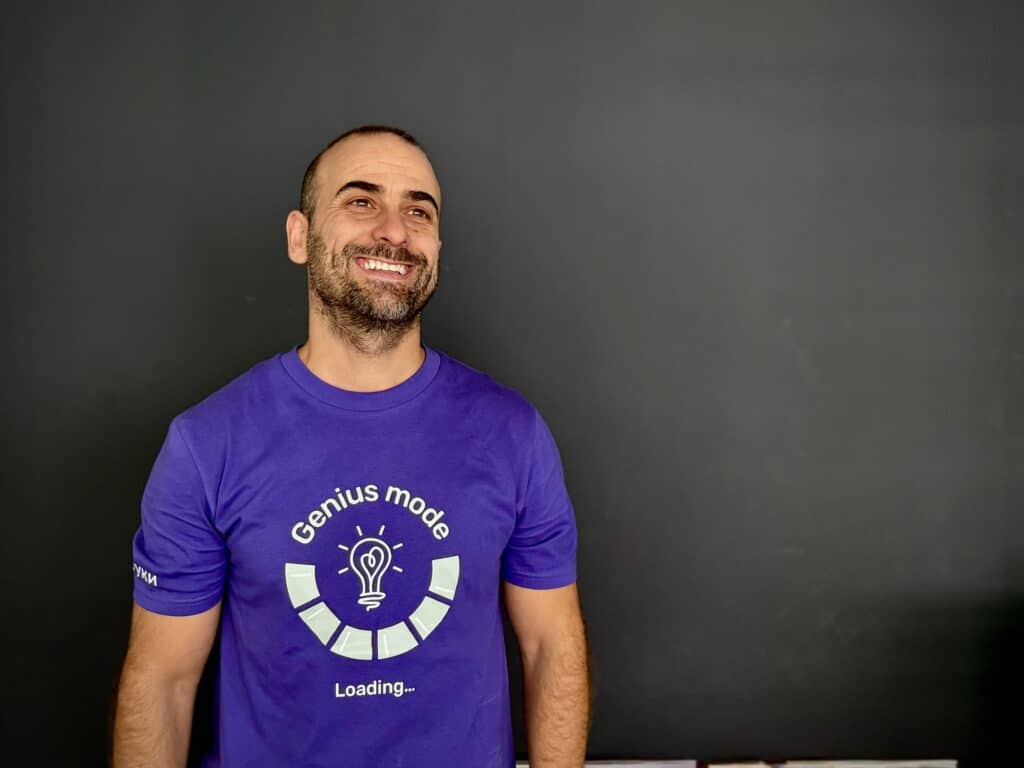
What role does technology play in education today?
Technology is everywhere. It has been part of our lives for a long time, and education cannot remain untouched by it. On the one hand, technology helps students become more engaged in the learning process. On the other, it gives teachers the opportunity to teach in new ways, with greater freedom and, I would say, a better understanding of the bigger picture.
One of the biggest challenges teachers face today is how to keep students’ attention in the classroom. This is a serious problem, and it is not necessarily because the teacher is not good at their job or because the subject itself is uninteresting. More often, students are facing enormous challenges. And here is the paradox. On the one hand, technology and life on social media, constant distractions, and the expectation that everything should happen instantly—in the two, three or five seconds that a short video lasts—all take away from students’ attention and ability to focus.
On the other hand, one solution is for teachers to use technology to engage students more actively and make education more practical. Many schools are already doing this through 3D printers, 3D scanners, robotics and green technologies. These are practical activities that children can do with their own hands, helping them feel much more involved in the learning process than when a teacher simply tells them something.
So teachers and the education system need to adapt to technology, as well as to how children experience and understand it, so that students can focus on its positive aspects?
Unfortunately, the truth is that we—people, teachers and the education system—have to adapt. The education system needs to become much more flexible. This is not just a problem in Bulgaria; it is a global issue. Education is a static system. People are afraid to change or challenge it because it affects every layer of society. That is why it is one of the most difficult sectors to transform. But in the world we live in, education can no longer afford to stand still. The world has changed, technology has changed the world, and AI has changed the world. Education as an institution must also change and adapt so that it can fulfil its most important function: preparing children for what lies ahead, helping them become better people and independent thinkers, and developing their ability to communicate, make decisions and think critically. For this to happen, education must adapt to the changes we are all experiencing.
This is also one of the messages we share with all the young people we work with, both in and outside school, including through the competitions we organise. They are growing up in a world where the old path no longer exists: you finish school in Year 12, graduate, go to university, and then have a clear idea of where you are going and what you will do with your life. That world is gone. In today’s world, the people who are most adaptable and most patient with their own development will ultimately be the most fulfilled and successful.
Given that education is such a conservative system, how can teachers and the system itself become more adaptable to the needs of today’s children?
This is partly what we are trying to achieve through our Buki platform, which provides ready-made programmes for teachers. It contains more than 900 hours of educational content that we have developed over nearly ten years through the Telerik Academy School and Technokrati. The platform is not intended to replace the education system. Quite the opposite: its purpose is to support and complement it with programmes covering subjects that interest students and are relevant to the modern world. These include financial literacy, green technologies and social-emotional skills—topics that allow students to learn things they find interesting and can actually apply here and now.
Another important factor is giving teachers greater flexibility and freedom in how they work in the classroom. To be fair, the Ministry of Education and Science has been making considerable efforts in this direction, including reducing teachers’ administrative burden and giving them more freedom within the framework in which they teach. However, introducing new and interesting subjects or teaching methodologies into schools is still difficult. Take the STEM approach—science, technology, engineering and mathematics—which has been gaining momentum in recent years. It still struggles to find its place in the mainstream education system because subjects remain separated from one another, and teachers have yet to find the right ways to collaborate. Once again, this kind of change needs to be supported from outside the traditional system, whether by organisations developing educational innovations or by the Ministry itself.
Ultimately, it is important to recognise that teachers have many different roles. I spent four years in the classroom myself, so I know what being a teacher involves. First and foremost, teachers teach. But very often, they also act as psychologists, communicating with and supporting their students. Sometimes they have to be negotiators, too, discussing programmes, training, trips outside school or innovative teaching approaches with the school principal. And, of course, they need to maintain an open dialogue with parents. Add to all this the preparation of resources and materials, testing and marking, and you have a whole range of responsibilities that can become very difficult to juggle. This is where technology can help. Innovative programmes and platforms can save teachers time, provide ready-made lesson plans, and offer tools and resources that help them break away from traditional teaching methods.
There is another important point that many teachers have yet to recognise: the role of the teacher is not changing—it has already changed. It is no longer what it used to be. Teachers need to understand that not knowing something is a perfectly normal part of teaching children. For me, this is one of the keys to education today. When teachers accept that not knowing is normal and part of the process, they feel free to learn alongside their students, explore things together and learn from one another in different situations.
When I taught computer modelling and information technology, I had students who became so deeply involved in Java, Python and other programming languages that they would come to me and say, “Sir, you can do it this way,” or “This is how I did it.” And sometimes I did not know what they were talking about. I would simply say, “Wow, well done!” It is important for teachers to accept that this is normal. It also helps reduce the distance between teachers and children. A student can realise: “Oh, my teacher doesn’t know everything either. So it’s okay not to know something. I ask questions, and that’s a good thing. There’s no shame in asking questions.” That is the final part of this shared learning journey: both the student and the teacher learn together and go through the process side by side.
Technology, artificial intelligence and the world we live in are showing us that one person cannot know everything while the other knows nothing. On the contrary, everyone has knowledge that someone else may not have, and they can exchange that knowledge—even at school, even in the classroom.
Is there resistance to introducing technology into education? Where does it come from, and is it the main obstacle?
It is certainly a serious problem. There is apprehension and, I would say, sometimes even fear. To some extent, this is connected to what we discussed earlier: teachers need to feel comfortable admitting that they do not know something. Part of the fear of technology comes from teachers worrying that they are unfamiliar with a particular tool. They may not know how to operate a 3D printer or may not feel entirely confident using the software for a 3D scanner. This uncertainty can make them reluctant to work with these technologies because they are afraid of showing their students that they do not know how to use them.
There is another concern associated with bringing technology into the classroom. A teacher might think: “I have valuable information to share, but if I introduce technology, that information may get diluted, and the students may no longer concentrate on the substance of the lesson.” The truth is that we need to find the right balance between technology, information, knowledge and the learning process, so that we can find the most appropriate approach for students. Children today are different from those who were in school 20, 30 or 40 years ago. They are growing up with a different digital DNA, and they learn in different ways.
There is one thing I want to emphasise: I do not believe that lessons have to be funny or entertaining, or that teachers need to juggle and perform to keep students amused. Absolutely not. Students are there to learn. They have a purpose. They are not there simply to be entertained. However, the learning process needs to include more practical activities, discussions, debates and hands-on work. The traditional lecture-based approach simply does not work. This fear of technology and innovation among teachers, and within the educational environment more broadly, often prevents us from closing the gap between teachers and students and improving the way new knowledge is shared.
Teachers often say, “Am I supposed to become a clown to entertain them?” To me, this suggests that they misunderstand the role of technology. Like children, they may imagine that technology is limited to Instagram, TikTok and similar videos.
Exactly. I completely agree. There are two important things to consider.
First, over the past three or four years, Bulgarian schools have developed STEM classrooms through the National Recovery and Resilience Plan, with a substantial amount of funding invested in them. Some schools have been very successful, while others have not been quite as successful. That is normal. I am very glad these technology classrooms exist because they should give teachers, schools, the education system and students a different perspective on what technology actually is and how it can be integrated into learning. Imagine students creating digital designs for T-shirts, key rings or mugs at school, recording a podcast, setting up a school radio station, or producing flooring for a chemistry classroom from recycled plastic. All of these activities can be approached through technology, offering both teachers and students a new perspective on what it means to use it.
But there is another important issue. For years, I have been arguing with parents and friends about this. Since the internet became more widespread in the early 2000s, people have increasingly tended to associate technology with entertainment and passive consumption. Yet technology can be so much more than that. The point is not to use technology just for the sake of it, nor to turn teachers into entertainers. It is to make learning more active, practical and relevant, while helping students understand how technology can be used to create, explore and solve problems. We need to move away from the idea that the traditional way of teaching is the only valid one. People often want to preserve the static model of education they experienced themselves because they worry that a different approach will force teachers into an unfamiliar role in which they have to perform or entertain students. But that is not what is required. Teachers need to be prepared for a contemporary approach to learning in which they recognise that they do not know everything, understand which tools they can use, and encourage students to use those tools correctly as well.
Tell me about your projects and how Technokrati contributes to improving education and introducing technology into schools.
For almost nine years, our main focus has been introducing young people to new technologies. We organise courses in robotics, programming and green technologies, and we support schools in their teaching. Today, our primary goal is to help schools introduce new technologies and processes, from 3D printers and laser-cutting machines to tools and programmes that teachers can use. We have also been organising hydrogen-powered model car competitions for students for six consecutive years. It is the only competition of its kind in Bulgaria, and we now have 18 teams from across the country.
What does the competition involve?
Teams from schools, each consisting of six to eight students and one teacher, build their own hydrogen-powered car at a scale of 1:10. The cars are approximately 50 centimetres long and are operated using a controller. Each has a fuel cell and an electric motor. Students learn how hydrogen is produced and produce it themselves. They have their own charging station, hydrogen containers and fuel cell. The fuel cell converts hydrogen, separating it into protons and electrons; the electrons then power the electric motor. During the competition, teams optimise their cars in several ways. They work on reducing the car’s weight, improving its handling speed and developing the driver’s skills on the track. We build a track measuring 20 by 12 metres—imagine a gymnasium with a floor area of approximately 350–400 square metres. The students compete for four hours. The winner is the team that completes the most laps, so the competition is about endurance rather than speed. All teams receive the same quantity of hydrogen containers and the same amount of energy. Their final positions depend on how well they have optimised their cars and how effectively they manage them throughout the four-hour race. We already have world champions and world runners-up. I would like to congratulate the students of the 18th William Gladstone School, as well as the team from the Bulgarian Association of Model Sports, with whom we have been organising the competition for years. I would also like to thank Burgas Municipality, with whom we have worked over the past three years to hold the national finals.
I would say this is a truly inspiring, hands-on competition in which children build racing cars with their own hands and demonstrate what they have learned. It is a great example of a genuine STEM project that brings together different student roles. There are mechanics, drivers, bodywork designers and designers responsible for the entire car. There is even a business development team, with young people looking for funding and sponsors to help improve their vehicles. It is a very interesting project. We are also sending students to the world’s largest robotics championship in South Korea. We are happy and proud to have organised the competition for the fifth consecutive year.
Another important part of our work is what we do together with Telerik Academy School, as well as the Buki platform, which offers more than 900 hours of educational content developed over the years and now available to teachers across the country. We currently have more than 300 schools and over 1,000 teachers actively using the platform. They access programmes covering social-emotional skills, STEM, financial literacy, green technologies and artificial intelligence—all subjects that we believe have a place in the education system. Our goal is to support the learning process and the education system, not to replace existing school subjects, but to offer a different perspective.
We also have our STEM centre, where we aim to showcase new technologies that are accessible to teachers, parents and children.
Finally, we want to develop innovations that can reach schools. What we have seen across Bulgaria is that a school’s size does not determine how much innovation takes place. What matters is how motivated the school team is—the principal, deputy principals and teachers.
Amazing things can happen. We have seen examples in smaller towns and villages such as Tryavna, Uzundzhovo and Pernik. At the same time, there are large, impressive schools in Sofia where not as much is happening. Education and inspiration can flourish regardless of location. They depend on teachers, school leadership teams and their motivation.
Technokrati is a member of EdTech Bulgaria. Why did you decide to join?
In a relatively small ecosystem such as Bulgaria’s, I believe it is very important for people working in education to know one another, help and support one another, and, last but not least, inspire one another. When I returned from Denmark almost ten years ago, it was incredibly valuable to meet other people who had also returned to Bulgaria and were developing projects here. It helped me realise that I was not the only “crazy” person doing this—there were other great people working on great things. To some extent, I think the EdTech community helps you realise that we are not the only “crazy ones” working in education—in the best possible sense of the word, of course. There are others out there, too. Being able to support one another and share signals that things are happening, even if progress is slow and difficult, is extremely valuable.
How easy is it to run an EdTech company in Bulgaria? What is the environment like?
I will be honest: the environment is difficult because education, not only in Bulgaria but everywhere, is a very long-term undertaking. When you develop something in education, it can take two, three, four or even five years to gain traction. Take our hydrogen-powered car competition as an example. During the first three or four years, nobody really knew about us, wanted to help us or offered us any kind of support. You have to build everything from scratch. You start with four teams, then six, then eight, then ten, gradually attracting attention until a sponsor, partner or new school comes along and decides to trust you.
As I mentioned earlier, you are working in a very conservative environment. To earn the trust of a school principal, a teacher or an entire school, you have to demonstrate your capabilities and show that you are reliable and genuinely committed to making things better—not simply trying to make money. Building that reputation takes time. That is why the first two or three years can be extremely difficult for many educational organisations, both financially and operationally.
There is also the issue of salaries. The education sector is not always competitive in terms of pay, which can make it difficult to attract and retain the best people. They may be tempted to move into other sectors where they can earn 30%, 40%, 50% or sometimes even 100% more than an educational organisation can afford to pay.
These are some of the challenges that all of us working in education face and try to overcome.
That is precisely why an organisation such as EdTech Bulgaria is helpful. It allows us to join forces, support one another wherever possible, and open doors to schools where we already have established partnerships.
What advice would you give to EdTech start-ups?
The first and most important thing is to be patient and to be absolutely certain that what you are doing is what you really want to do. Sometimes those two things do not align. This is a very challenging sector. In our case, the path was clear. We knew what we wanted to achieve, what we wanted to bring into schools and what we wanted teachers to have access to.
Another important consideration in the early years is to maintain an appropriately sized team, establish an efficient way of working and keep expenses to a minimum. I have seen educational start-ups receive funding or take out loans and then rent large premises of 500 or 800 square metres, set up schools or training rooms, and invest in huge numbers of educational kits—for example, buying 20 to 40 robotics kits. That can become a major problem because the overheads leave them without the resources to hire one or two good people to work with. For the first three years, we did not have an office. We ran classes at different locations, carried robots around with us and had a tiny 15-square-metre storage room. We literally carried the equipment from one place to another.
So that is my practical advice: be flexible, keep your spending under control and, above all, be careful with fixed costs. They can become a swamp that pulls you under very quickly. If your fixed costs remain manageable and flexible, your organisation has a much longer runway and can respond more quickly, making creative decisions as circumstances change.
Finally, where would you like to see education in five years’ time?
There are two things I would like to see. First, I want to see confident teachers who feel supported and are comfortable admitting that they do not know something and learning alongside their students. This is something I would really like to see, and I know that the approximately 60,000 teachers in Bulgaria need support in this area. We are trying to help through the Buki platform and its ready-made programmes, by sharing good practices and by drawing on our own experience to support teachers.
The second thing I would like to see is better, more structured communication between institutions and organisations like ours. I believe we can introduce educational innovations much faster and with far less friction. I would really like to see this happen in Bulgaria, because it is already happening elsewhere. The Ministry of Education and Science does not have to be responsible for constantly developing innovations, whether technological or educational. It faces much bigger and more complex challenges that it needs to address. At the same time, organisations like ours focus on a particular sector or segment. We keep working at it, refining and refining, until we develop something that works and becomes a high-quality product. We test with teachers, collect feedback and build a technology team. That team develops an innovation that can be adopted naturally and that raises the standard and quality of education. I would very much like to see dialogue and genuine partnerships that deliver results for the people who matter most: students and teachers. I would like the entire system to work like a well-oiled machine, engaging students naturally and effectively.
And perhaps the biggest dream of all is for students not to want to leave school—for them to want to be there and to realise that learning is one of the most wonderful processes they can carry with them throughout their lives.